




“Knight: Who are you?
Death: I am Death.
Knight: Have you come for me?
Death: I have walked at your side for a long time now.
Knight: That I know.
Death: Are you prepared?
Knight: Wait a moment.
Death: You all say that. But I give no respite.”
Ingmar Bergman, The Seventh Seal
Life and death currently hold centre stage in both business and sports. AI is expected to bring more of both than any previous technological shift. And, in the world’s biggest sport, 48 teams have been battling it out until all but one have been defeated and a World Cup winner has been crowned.
This year’s World Cup had 50% more teams competing compared to the last one. It is easy to appreciate why this is the case with the commercial opportunity being so vast. One beneficiary is the Italian trading card company Panini, which expects to double the sales of merchandise to $1.5bn compared to the last World Cup in 2022.
For most young World Cup fans, Panini is the only Italian football reference they have. Despite being the tournament’s joint second most successful country ever – a total of four wins, only one behind Brazil – this World Cup will be the third in a row without Italian participation. Adding insult to injury, in its last two World Cup appearances (2010 and 2014), Italy was knocked out in the group stages. In the 2014 tournament their group of four included three previous World Cup winners: England, Uruguay, and Italy. In an illustration of startups challenging incumbents, it was the footballing Lilliputian country Costa Rica that came top of the group, eliminating both Italy and England on the way.
Italy is going to get some extra attention in this letter. Not only because it is the home of our newest office, but mainly because it is a good illustration of some of the key points we intend to make. Despite its richness in talent, brands, and history, it has designed its routines and institutions to protect the status quo instead of enabling future wins.
Its celebrated football team is a case in point. The national association has made it its main obligation to cling on to old players and old methods like an incumbent holds on to its highest margin but declining products.
Meanwhile, less seasoned football countries like Norway have patiently developed gifted players through a nationwide coaching programme, excellent all-year training facilities, and a culture that prioritises long-term player development. At first, a method like this yields little result, but the compounding effect is impressive. Tech and sports are young people’s games. When in doubt, always bet young and new.
“Capitalism has two sides: The system creates an ever-growing pile of losers while concurrently delivering a gusher of improved goods and services.”
Warren Buffett
In light of the impact that the latest innovations are having on companies worldwide, it is timely to revisit the eternal management question – why do some companies and organisations adapt to changing environments while others do not? Evolutionary economics has tried to answer this question over the last century. Its perhaps most famous contribution came with Schumpeter and his ‘creative destruction’ description. Its modern form was born in 1982 when Richard Nelson and Sidney Winter published ‘An Evolutionary Theory of Economic Change’.
Nelson and Winter found that companies adapt in a similar way to living organisms. Not by creativity or optimisation, but by routine: invisible and compounding habits that make execution fast in areas they are used to but often slow and rigid when faced with new problems. Simplistically, they concluded that routines are for a company’s behaviour what DNA is for a human’s personality.
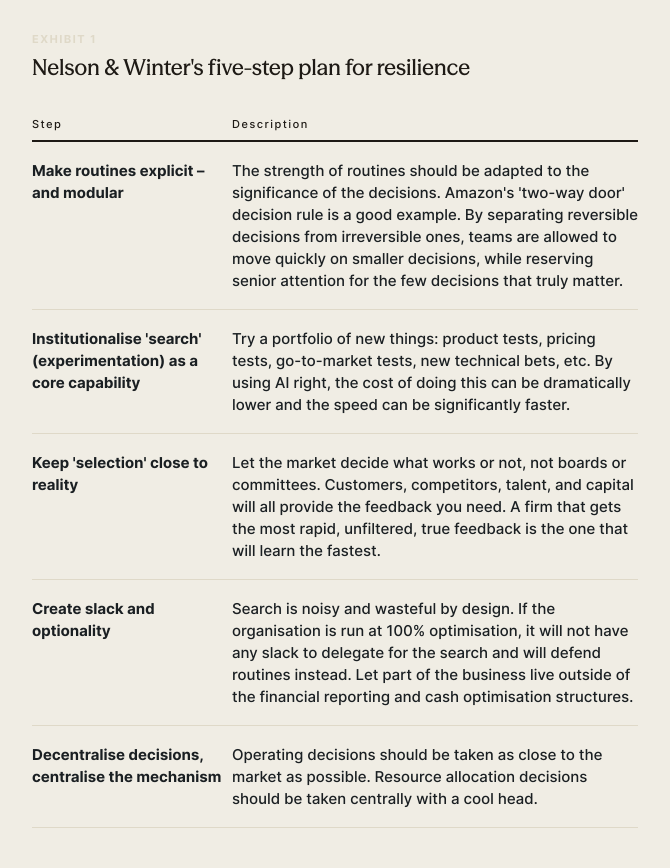
When a company faces a problem that its existing routines cannot solve, it starts searching. It experiments, hires new talent, tests new products, and tries new ways of working. But renewal is hard because every company is shaped by its own history. The ones with enough slack to experiment – and with routines that are more easily changeable – have the best chance of adapting. They developed a five-step plan for resilience.
“For to everyone who has, more will be given, and he will have an abundance. But from the one who has not, even what he has will be taken away.”
Matthew 25:29 (ESV)
Running a company is an unhealthy endeavour. Within our remit of evaluating companies, we often quote the fact that in Europe some 35,000 startups have received venture funding, but only ~1% of these have turned into unicorns. Not all unicorns are built to last; the percentage of them that turn into large, profitable listed companies is even smaller.
Once you are a listed company, the competition to stand out is equally brutal. Another piece of research that we often quote is that of the American professor of finance Hank Bessembinder, which shows that only a single-digit percentage of all listed companies beat the returns of treasury bonds, implying that a vast majority of all companies are destroying capital.
A silver lining, albeit questionable, is that the pain that the underperformers cause is shorter and shorter. In 1964, the average company remained in the S&P 500 for around 33 years; by 2016, that figure had fallen to 24 years, and by the start of 2026 it had dropped to just 15 years. AI will almost certainly amp up the clock’s speed further.
This means business resembles the ongoing World Cup struggle – you either win or you get kicked out. The prize money for anyone from the middle to the bottom of the pack is minimal. When McKinsey analysed more than 2,300 of the world’s largest companies over a decade, it found that economic profit – total profit after the cost of capital – follows a power law with extraordinary concentration. The top quintile captures roughly 90% of all economic profit created.
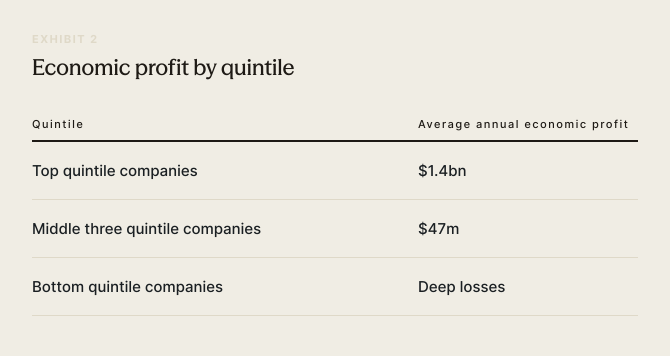
Another interesting observation they made was that business performance shows no mean reversion, rather the opposite. In 2000–04, the top quintile captured a collective $186bn in economic profit. A decade later, that figure for the same companies was $684bn. The best companies compound by attracting the most capital and the best talent. What was reverting to the mean over time, however, were valuation multiples, making it relatively cheaper to invest in the best companies – another phenomenon Sprints likes to exploit, on top of managing a concentrated portfolio and using a quality-focused checklist.
However, even a concentrated portfolio is likely to show significant power law effects, as exemplified by the broad European index (EURO STOXX 600).
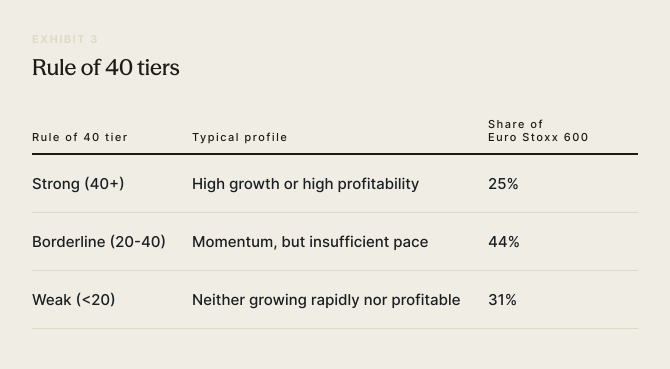
You could imagine that those companies that are neither growing rapidly nor particularly profitable are busy on all levers to try to change their situation. In spirit, they all are. However, the performance categories above are a very good measure for how much the teams actually get done. The bottom companies typically do too little, too late. The tougher question to answer is why, and a lack of confidence and courage is our best guess. Hopefully research like this can inspire a change in attitude.
Drastic action is desperately needed to change and improve one’s position in the business pecking order. In a rather brutal illustration of the economy’s incessant destructive powers, the odds of moving down from the middle three quintiles to the bottom quintile are almost twice as high (14%) as the odds of moving from the middle to the top quintile (8%). This also means that only 1 in 12 companies manages to jump to the top quintile. These odds are sobering, but they also make life simpler. You really only have one choice – fight to improve your position as if your life depended on it. Throw everything you have at it.
“It’s better to burn out than to fade away.”
Neil Young, “Hey Hey, My My (Into the Black)” (1979)
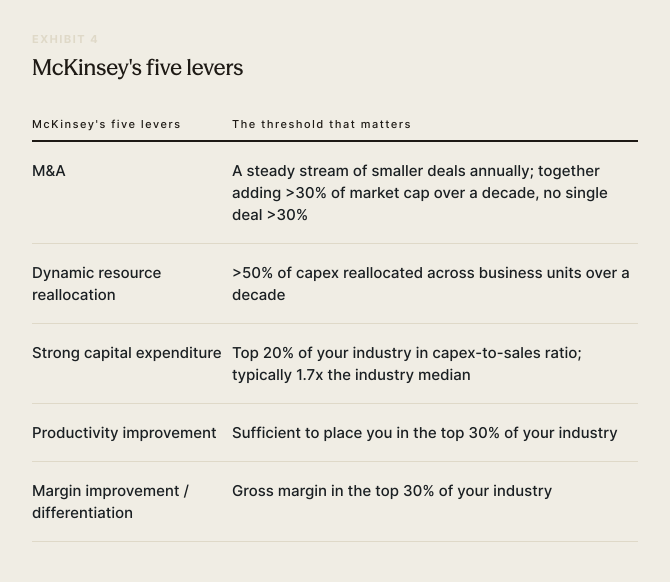
In its research, McKinsey identified five levers that, when pursued persistently and with sufficient aggression, are the key drivers behind the few companies that manage to make it from the middle of the curve to the top quintile. For companies pulling one or two levers, the odds of reaching the top quintile more than double, from 8% to 17%. Three levers bring those odds to 47%.
For all levers but one – capital expenditure – the upside of trying is much larger than the downside from trying but failing, meaning that all companies should try to do more of all of it. Capex has a more neutral risk-reward, meaning that companies need to be more precise with the need and size to make sure the rewards are greater than the risks.
Acquisitions are, in theory, a big risk but when done as steady, repeated, smaller add-ons or expansions, they statistically enhance the chances of moving up to the top quintile while lowering the risk of slipping down. Looking at the research, bold action has by far the best chance of success. Doing too little is a doomed strategy.
What makes companies hesitate is likely that they fail to see the dangers. They are not paranoid enough because businesses rarely die dramatic deaths. The renowned Harvard professor Clayton Christensen has described this process eloquently: “A company that is losing its momentum and refuses to disrupt its old way of working does not collapse suddenly, it fades with dignity – still serving core customers, still growing in absolute terms – while their share of the future market quietly approaches zero.”
“Sustained economic growth requires innovation, and innovation cannot be decoupled from creative destruction, which replaces the old with the new.”
Daron Acemoglu and James A. Robinson, Why Nations Fail: The Origins of Power, Prosperity, and Poverty
After Italy’s World Cup humiliation in 2010 (finishing last in a group including Paraguay, Slovakia, and New Zealand, one of the weakest in World Cup history), the beloved football hero Roberto Baggio was given the responsibility for renewing Italy’s footballing methodology, coaching, youth development, and scouting. A year later, he published a 900-page report aiming to transform Italian football from the ground up. He proposed sweeping modernisations, basing new player development on modern tools and data. Two years later, he resigned in frustration, describing his report as a ‘dead letter’ and blaming the football association for its unwillingness to change.
If the Italian football association does not wake up from its slumber, future generations of World Cup fans may be entirely out of Italian references. Citing its strength in digitisation and innovation, the global football association FIFA recently announced that, from the World Cup 2030 and onwards, it will replace Panini as its exclusive supplier of football cards and similar merchandise with the US-based company Fanatics.
Italy and slowing businesses alike can learn a great deal from Fanatics. The company used to be a sleepy, old, licensed merchandise seller. Through a long string of acquisitions, investments in exclusive content deals, and new digital product innovations, it has reinvented itself. Today, it is one of the highest-valued private companies in the world, last valued above $30bn.
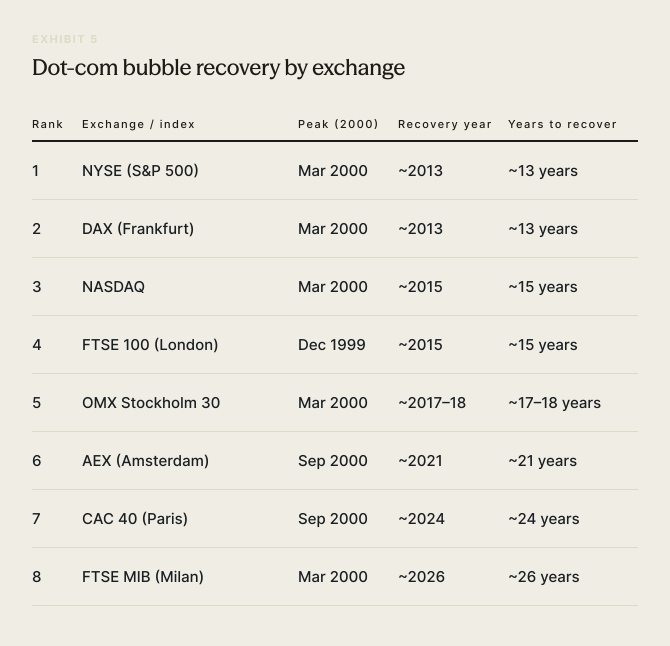
Italy needs more companies like Fanatics. Earlier this year the Milan stock exchange received some attention for finally recovering to the highs reached before the dotcom crash. This is, of course, a positive achievement. It only fades when comparing it to everyone else’s achievement. Italy was one of the last Western countries to make the recovery.
Recently, Italy produced one of Europe’s most successful tech companies – Bending Spoons. But when it decided to list, it chose Nasdaq in the US. In his book (The Political Economy of Italy’s Decline, 2018), the Italian economist Andrea Lorenzo Capussela suggested revolutionary reforms that would cease to protect and subsidise old, vested interests while opening markets to force through accountability and productivity. Some of this is making its way through the political system and hopefully the Bending Spoons of tomorrow will be floated in the old trading floor of Milan.
Another Italian, Mario Draghi, the former Italian prime minister and European Central Bank president, made similar recommendations on a European level. Commissioned by the European Commission to diagnose European competitiveness, he concluded that Europe has talent, capital, and industrial depth but too much regulation that serves to protect the old and too few incentives to build something new. Unsurprisingly, his recipe for improvement rhymes with that given to the companies earlier in this letter – abandon yesterday, make decision-making easier, and reallocate capital to the new great things that can win in the future. The report had a lasting effect and the EU has adopted competitiveness as its organising principle. But relatively few of the structural reforms have yet been implemented.
“Anxiety is the dizziness of freedom.”
Søren Kierkegaard, The Concept of Anxiety (1844)
Sprints is a bottom-up research firm. Our job is not to preserve every company, every thesis, or every historical attachment. It is to keep reallocating capital and attention to the best companies and to be patient with the few companies that can compound through a changing environment.
As discussed throughout this letter, we believe that similar yardsticks can successfully be used in any human activity like associations, governments, and, not least, individuals. Since this is a summer letter, we thought we should therefore finish off with some self-help advice for your upcoming break.
In his renowned book ‘Essentialism’ (a long-time Sprints’ favourite), Greg McKeown suggests this approach to creatively destruct yourselves over the summer:
Start with a couple of days of resting, sleeping, and recovering. Once you have acquired some distance to your day-to-day routine, list the projects, commitments, relationships, and habits that rule your life today. Rank them in terms of whether they give you energy or take energy away from you. For each item also ask yourself, “If this were not already in my life, how hard would I work to bring it in?” Finish the work by cleaning up the list by removing the things that cost you energy and/or that you would not bring into your life if it were not already there.
Greg McKeown
The end goal should be to keep the few things you love and devote much more of yourself to them.
McKeown cunningly pointed out that priority used to be a singular word, and our biggest mistake was to make it plural. As for everything else – if you do not bring creative destruction to yourself, you run the risk of someone or something else bringing destruction to you.
Have a great summer!
Henrik and the Sprints team
Milan, 8th July 2026
P.S. – After a tough review of Italy, we want to finish this letter by quoting one of its foremost poets and philosophers: Dante Alighieri. Few poets suit this letter better than Dante. He wrote The Divine Comedy (1321) in exile trying to understand how a person, a city, and a soul lose their way, and how they might find it again.
After the opening line “Midway upon the journey of our life, I found myself within a forest dark, for the straightforward pathway had been lost”, he travels through Hell, Purgatory, and Paradise to find the right path. His final discovery is not power, efficiency, or victory, but alignment with his passion. After c. 1,000 pages, the last line of his text is broadly considered one of the most beautiful in Western literature. And it is quite possible that Dante invented both ‘Essentialism’ and business strategy in this one poem: stop being pulled in every direction, accept the journey through hardship to cleanse and renew yourself, and start to focus on the things that really matter. The things you love.
“But now my will and my desire were turned,
Like a wheel in perfect balance,
By the Love that moves the sun and the other stars.”
Dante Alighieri, Paradise